Presentation at SpliTech 2026
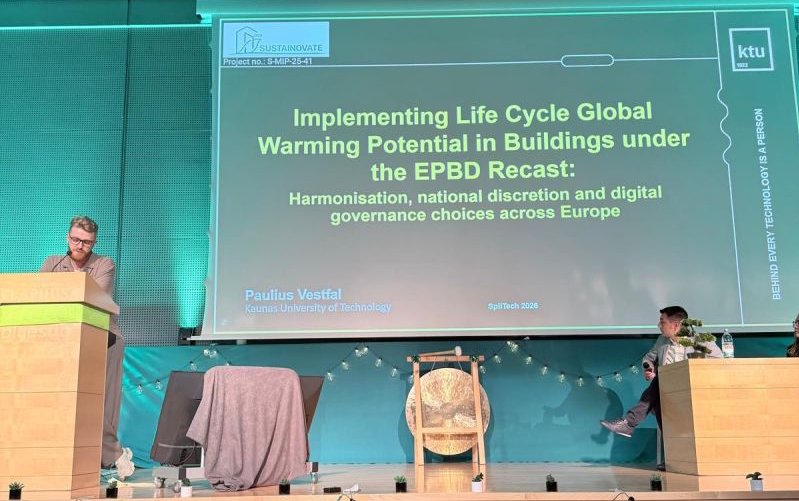
On 23 – 26 June, 2026, the SUSTAINOVATE project was presented at SpliTech 2026, the 11th International Conference on Smart and Sustainable Technologies, held in Croatia.
Representing the project, PhD candidate Paulius Vestfal presented the conference paper “Implementing Life Cycle Global Warming Potential in Buildings under the Energy Performance of Buildings Directive Recast: Harmonisation, National Discretion and Digital Governance Choices across Europe.”
Building on the project's previous research presented at MATBUD 2026, this study expands the discussion from the methodological requirements of life-cycle Global Warming Potential (GWP) assessment towards the comparison of national implementation strategies and digital governance approaches across Europe.
The research investigates how European countries are implementing the new life-cycle GWP requirements introduced by the revised Energy Performance of Buildings Directive (EPBD). It examines how Member States can balance harmonised European requirements with the flexibility needed to reflect national regulatory frameworks, data availability, and digital maturity.
The study compares implementation approaches in five European countries, France, the Netherlands, Denmark, Sweden, and Finland, analysing differences in regulatory frameworks, environmental data availability, digital tools, and methodological choices. Based on this comparison, the research introduces a convergence–divergence framework that illustrates where European countries are moving towards common implementation practices and where national approaches continue to differ due to regulatory, methodological, and digital governance choices.
Special attention is given to Lithuania as a case study, demonstrating that countries with limited Environmental Product Declaration (EPD) availability can implement the revised EPBD through transparent methodologies, well-designed generic databases, and gradual digitalisation of life-cycle assessment processes. The research also highlights the growing role of digital decision-support systems in supporting transparent, consistent, and scalable implementation of life-cycle assessment across Europe.
The paper was prepared by Paulius Vestfal, Anneliis Muravleva, Anuja Vivek Bhosale, Eglė Klumbytė, and Lina Šeduikytė.